Keep a Personal Creative Project Moving in Short Sessions
Compare three ways to define the next small task in a personal project, from a simple action list to a prepared restart note, and choose a method that fits how you work.
You open the sketchbook, reread the notes for your short story, and spend the first stretch of your available time trying to remember what you meant to do next. The project has not stopped because you lack ideas; its next action is hidden inside a vague instruction such as “work on the story.” A small, visible task can make it easier to begin, especially after a pause.
For a self-directed project, a useful next step is an action that can be understood without redesigning the whole project. It should point to a particular material, decision, or change: “write three possible endings,” “trim the blue paper into leaf shapes,” or “choose the reference photo for the next study.” Three methods can help: keeping an action list, using a session-sized task card, or leaving a restart note. Each method addresses a different kind of friction, so the choice depends on what makes it hard to return.
Use an action list to keep separate tasks visible
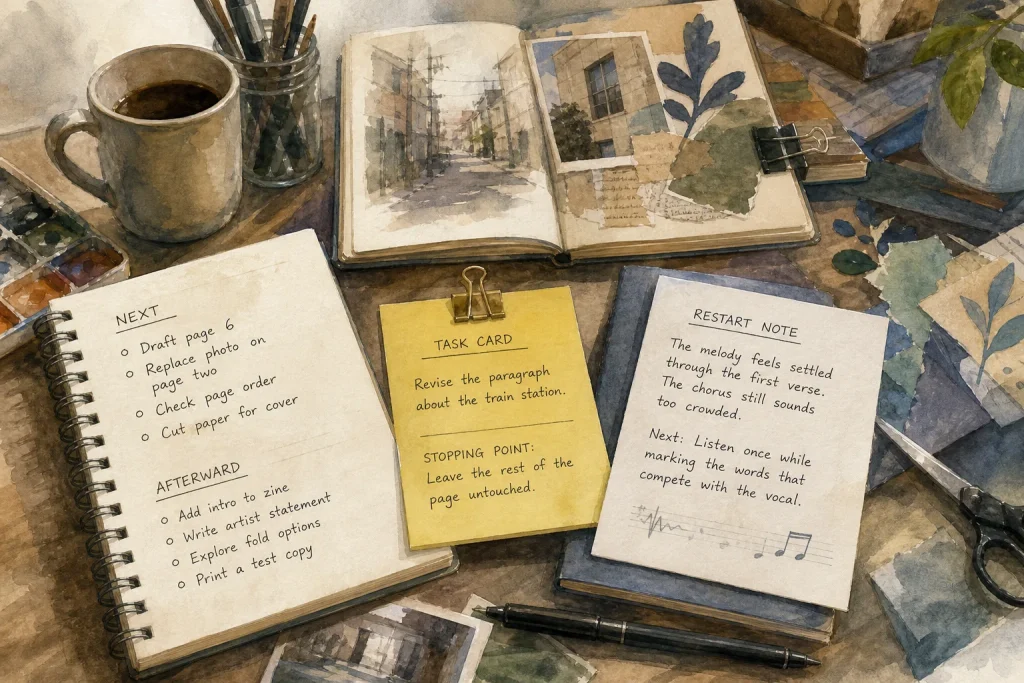
An action list is a short sequence of concrete tasks, usually kept in a notebook, a text file, or a basic notes app. It works well when you can see the project’s parts and the work does not depend on one complicated decision. A list for a handmade zine might include drafting the next page, selecting a photo, checking the page order, and cutting paper for a cover.
The main advantage is visibility. Instead of holding several unfinished intentions in your head, you can look at the list and choose an item that fits the time and materials you have. Keep each line specific enough to start. “Improve the zine” invites planning; “replace the blurry photo on page two with one of the saved street images” describes an action.
Lists can become discouraging when they turn into a catalogue of everything the project might eventually need. Separate immediate actions from later ideas. A short “next” section might hold only tasks that are ready to begin; an “afterward” section can hold possibilities that need more thought. When an item keeps returning to the list, ask whether it is too broad, blocked by a decision, or no longer relevant.
This approach suits people who like choosing from a menu and whose projects have several independent parts. It is less helpful when the next task depends on remembering a subtle idea, such as the tone of a poem or the reason a particular color was chosen. In that case, a list may tell you what to do but not how to re-enter the work.
Use a task card to give one session a clear boundary
A task card narrows the focus to one piece of work that can make sense in a brief, self-chosen session. It may be an index card, a sticky note, or a single note on your phone. Write a verb and an object: “sketch two window shapes,” “sort the recorded interview clips by speaker,” or “revise the paragraph about the train station.” Add a stopping point, such as “leave the rest of the page untouched.”
The stopping point matters because creative work can expand to fill whatever time is available. A task that is visibly bounded is easier to approach when you have only a little energy or a short opening in the day. You are not promising to complete the whole project. You are choosing a unit of attention with a clear edge.
Task cards suit projects with many possible directions, or days when deciding among them takes longer than beginning. They also suit people who prefer a physical prompt: a card clipped to a sketchbook can bring the next action into view as soon as the book opens. The tradeoff is that a card can become stale if the work changes. Treat it as a suggestion, not a contract. If the task no longer fits, rewrite it before starting.
Keep the card small in scope, but not so small that it becomes meaningless. “Open the drawing app” may be easy, yet it does not say what the session is for. “Open the drawing app and test brush textures on the tree line” gives the action a purpose and an observable stopping point.
Leave a restart note to preserve the thinking behind a pause
A restart note is a brief message to your future self, written at the end of a session or whenever you need to stop. It records where the project stands, what you were considering, and the first action to take next. For example: “The melody feels settled through the first verse. The chorus still sounds too crowded. Next, listen once while marking the words that compete with the vocal.”
This method is especially useful for work that depends on context: a story with several characters, a collage with pieces arranged on a table, a song with unfinished edits, or a photo series with a developing visual idea. The note preserves more than a task name. It captures the thinking that might otherwise be difficult to reconstruct after a pause.
A restart note does not need to explain the whole project. Too much background can become another document to read before you act. Include only what your future self is likely to forget: the unresolved choice, the reason for a temporary arrangement, or the next useful comparison. If the project exists in a physical space, note what must be left in place or packed away. “Keep the two green scraps beside the paper mock-up; compare them before gluing” can be more helpful than a general reminder to continue the collage.
This approach suits projects with a strong thread of thought or a physical setup that might change between sessions. Its limitation is that a note cannot remove every uncertainty. Sometimes you must make a fresh choice when you return. The note’s job is to make that choice easier to reach, not to settle every creative question in advance.
Match the prompt to the obstacle you face
Start by naming what most often delays you. If you have several clear tasks and struggle to pick among them, use an action list. If you know the direction but find the first move too large, use a task card. If you forget why you made a decision or where your attention was headed, leave a restart note.
Use these checks to choose and revise a prompt:
- Observe whether you can name several independent tasks; if so, write a short action list, but if the list keeps growing, move speculative ideas to an “afterward” section.
- Observe whether you know the direction but cannot begin; if so, write one task card with a verb, an object, and a stopping point, but if the task still feels broad, narrow it to one visible change.
- Observe whether you forget the reasoning behind a choice; if so, add that reason and the next action to a restart note, but if the reasoning is no longer relevant, record the current decision instead.
- Observe whether a task depends on a choice you have not made; if so, make the choice itself the task, but if the needed information is missing, note what you need to inspect or gather first.
- Observe whether the prompt names a tool or material you cannot access; if so, choose a ready task or gather the material, but if neither is possible, record the obstacle and a useful alternative.
- Observe whether you return and immediately change the plan; if so, rewrite the prompt to fit the project now, but if the project’s direction remains unclear, use a note to capture the open question before proceeding.
A prompt should let you know what to touch, open, write, compare, or decide. Replace “work on the print” with “open the lino block and redraw the small branch that disappeared near the edge.” If the task depends on information you may forget, add that information to a restart note.
Work through a paused photo essay
Imagine, hypothetically, that you are making a small photo essay about a neighborhood bus stop. You have a folder of images and a draft sequence in a presentation file. The order feels uneven, but you have not decided whether the problem is image choice or pacing. Writing “finish the essay” would leave too many decisions for the next session.
First, use the saved photographs and the existing presentation file as your inputs. Make a task card: “Place the six strongest images in a temporary sequence; do not write captions yet.” Next, move the images into an order without editing them or adding text. Then review the sequence and note what seems unresolved. In this hypothetical situation, the empty bench appears to work better near the beginning, while two rainy-day images seem to compete for the same place. Write a restart note: “Keep the empty bench near the beginning. Next, compare the two rainy-day images and decide whether both are needed.”
The result is a visible draft sequence and a clearly named decision, not a finished essay. The tradeoff is that captions remain untouched. If the images already felt settled instead, the better next action would be to draft one caption rather than rearrange the sequence.
Leave the next action where you will find it
At the end of a session, take a moment to make the next step visible. Save the file with a clear name, put relevant materials together if they can be stored safely, and write one sentence about what comes next. If the project is digital, a note beside the document link can be enough. If it is physical, a card tucked into the sketchbook may do the job.
Keep the prompt honest about uncertainty. “Choose between the two endings” is clearer than “finish the ending” when you have not made the choice yet. If returning reveals that your earlier plan no longer fits, revise it without treating the change as failure. A useful next step is a starting point, not a binding plan. Before you close the project, make sure the prompt names both the next action and any detail you would otherwise have to reconstruct; that small handoff can save your attention for the creative decision itself.