A Room-by-Room Reset for Household Paper
Create a simple route for incoming mail, handle papers that need action, and store important household records where you can find them.
A school form arrives beside the front door, a utility notice lands on the kitchen counter, and a receipt slips into a shopping bag. Household paper is easier to manage when each item has a clear next destination: take action, keep it for reference, or dispose of it safely. A few shared locations can replace piles without requiring a home office or elaborate filing system.
Gather a recycling bag, a pen, one small incoming-paper tray, one action folder, and a few broad-label folders for records. Work through the places where paper collects, making a decision for each item instead of carrying an unsorted stack from room to room.
Set one landing place near the entrance
Choose a tray, wall pocket, or shallow basket near where mail and school papers enter the home. Use it only for items that have not yet been sorted. Keep it apart from keys and loose change so papers remain visible.
As you bring items in, discard obvious advertising and envelopes you do not need. Put the remaining papers in the tray. If someone else brings in the mail, agree that this is the shared destination. When the tray fills, sort it before adding more; that signals a need to make decisions, not to buy a larger container.
Keep the kitchen action folder temporary
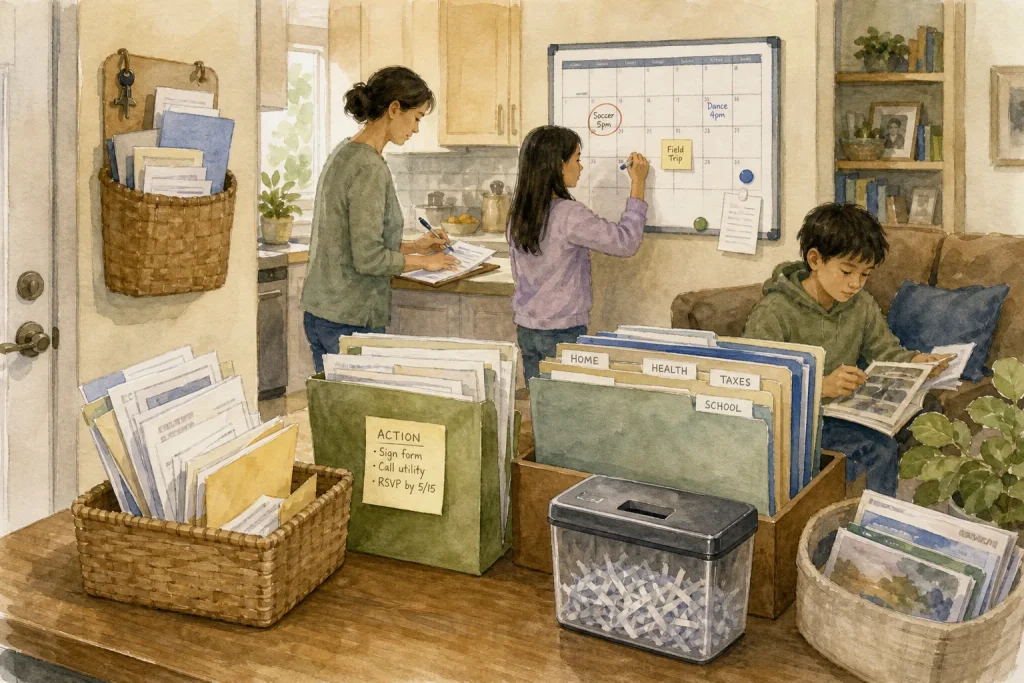
Reserve a folder or tray on the kitchen counter for papers requiring a response, such as a form to sign, an invitation to answer, or a notice to review. Write the next action and due date on a note if they are not clear on the paper.
Once you complete an action, move the paper out of the folder. If the paper needs a later follow-up, put it in a separate “Waiting” section and add a reminder to check it. If the counter is shared, use a folder that closes so private details are not left in view.
Put shared schedules where the household plans
Keep current appointment reminders, activity calendars, and school notices near the place people use to plan the day. A wall calendar, clipboard, or wipe-clean board works if everyone knows which one is current.
Transfer only useful coordination details. For instance, add an event date to the calendar, return a completed form to the school, and dispose of a notice that has no remaining reference value. Keep private information in a closed folder rather than posting it where visitors can read it.
Clear living-room clutter without relocating it
Side tables, bookshelves, and sofa cushions often collect catalogs, booklets, receipts, and notes. Pick up one paper at a time and decide whether it needs action, has a reference purpose, belongs to someone else, or can be discarded. Return borrowed documents to their owners, and dispose of outdated promotions and duplicate printouts.
Keep a manual if it helps you use or maintain something you still own. If you can identify the product by its name and model information, record those details in a household note and dispose of a bulky booklet you no longer need. Put a warranty or care document with the relevant product records. A small reading basket can hold magazines you genuinely plan to read; when finished, pass them along or dispose of them.
Protect personal papers and check retention rules
Gather private correspondence, appointment cards, and personal notices into a closed folder or drawer. Separate items that need action from records you need to retrieve. Avoid leaving sensitive papers in an open basket or shared space.
For papers with account details, identification numbers, or other sensitive information, use a cross-cut shredder or follow the issuing organization’s disposal guidance. Rules for keeping originals and disposing of legal, financial, tax, health, or other official documents can depend on the document and where you live. If you are uncertain, ask the issuing organization or a qualified professional before discarding an important record. A digital scan may be useful, but do not assume it replaces an original unless the relevant requirements say so.
For records you decide to retain, use a dry, secure place such as a filing drawer, document box, or locking cabinet when privacy calls for it. Broad labels like “Home,” “Health,” or “Taxes” are usually easier to search than a separate folder for every sheet. Keep originals and copies according to the issuer’s instructions, and return documents to their labeled folder after use.
Use a short routine to keep papers moving
Choose a regular time to sort the entryway tray and kitchen action folder. For each item, check these points and follow the matching decision:
- Observation: The paper asks for a reply or signature. If it does, then complete the action or put it in the action folder with a due date; otherwise, check the next item.
- Observation: The paper names an event or appointment. If it does, then add the needed detail to the shared calendar; otherwise, check the next item.
- Observation: The paper is an official record with possible legal, financial, health, or tax consequences. If its retention requirements are clear, then store it as directed; otherwise, ask the issuer or a qualified professional before deciding.
- Observation: The paper contains sensitive personal information. If it does, then use the issuer’s disposal guidance or a cross-cut shredder when discarding; otherwise, use the ordinary disposal route if it has no remaining purpose.
- Observation: The paper relates to a product you still own. If it contains useful warranty, care, or service details, then file it with that product’s records; otherwise, keep only the product-identifying information you need and dispose of the booklet.
- Observation: The paper is an old promotion, duplicate, or finished reading material with no reference value. If that is true, then recycle or pass it along; otherwise, identify its next action or labeled storage location.
- Observation: Another person must respond or handle the paper. If so, then place it in the agreed shared location and name the responsible person; otherwise, handle or file it yourself.
Hypothetical worked example: Imagine a household has a school form due soon, a utility notice with an upcoming service date, an appliance receipt, and an old catalog in the entryway tray. First, one adult signs the form and places it in the folder used for school returns. Next, they add the service date from the notice to the shared calendar and file the notice with current household records. They check whether the receipt is still needed for a warranty or service question; in this hypothetical, it is, so they file it with home records. The catalog has no useful information, so they recycle it. The result is a clear destination for each paper, while the tradeoff is taking time to review the receipt rather than discarding it automatically.
If a folder repeatedly fills, review its contents and labels before adding storage. A paper can land in the wrong room; what matters is having a known place to return it and a routine for deciding what happens next.