Plan a Week of Flexible Meals Without a Rigid Menu
Build a loose dinner plan around familiar ingredients, realistic schedules, and clear choices about preparation, leftovers, and backups.
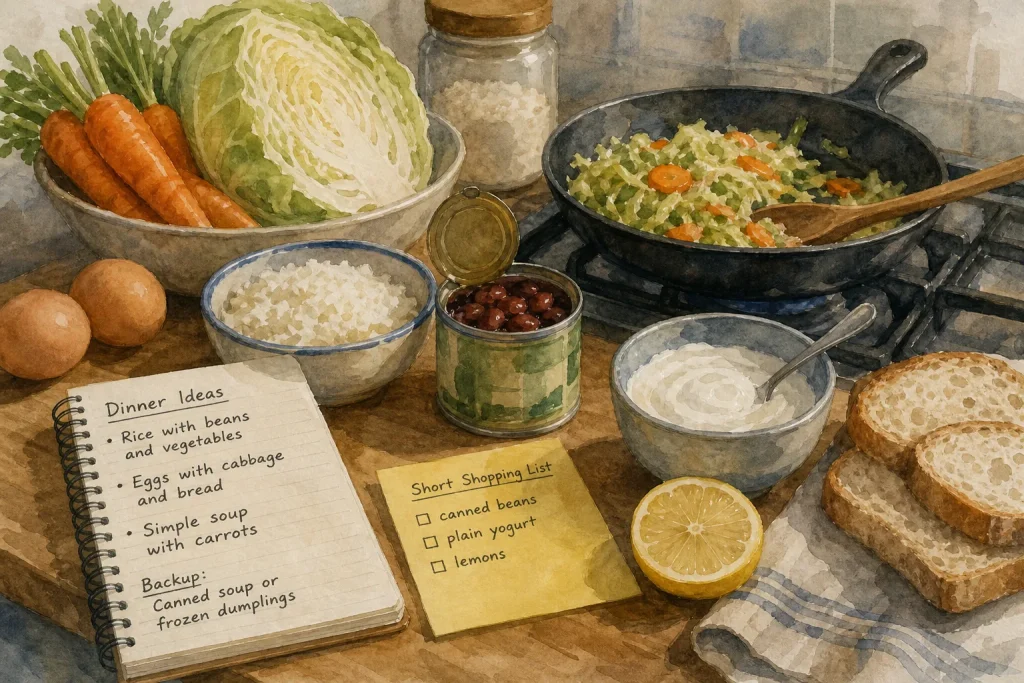
On Sunday evening, an imagined household sees carrots, half a cabbage, eggs, and rice in the kitchen. Tuesday will be busy, and someone may bring home lunch leftovers. Rather than assigning a separate recipe to every night, the household can plan a few familiar meals and decide which one fits each evening’s time, appetite, and available ingredients.
This is a way to organize dinners, not a requirement to turn every ingredient into a different dish. A short menu, a modest shopping list, and one backup can provide enough structure. The key is to decide what the household is likely to eat and leave room to swap a meal when the week changes.
Plan around the week’s actual schedule
Begin with the calendar. Mark evenings when someone will be home late, when dinner needs to be quick, or when people may eat at different times. Then check the refrigerator, freezer, and pantry before choosing meals. This makes the plan reflect the food and time already available.
For the imagined household, Tuesday calls for a quick dinner, while another evening may allow more cooking. The carrots and cabbage are already on hand; rice is in the pantry. A short shopping list might add canned beans, plain yogurt, and lemons. Those ingredients support several familiar meals, but the household should buy them only if they suit its tastes and needs.
Write down a few dinner options rather than assigning each one to an exact day. For instance: rice with beans and vegetables; eggs with cabbage and bread; or soup with a side of carrots. If the late meeting runs longer than expected, the household can choose the simplest option. If plans change, it can move another meal to a different evening.
Choose meals with overlapping ingredients
Overlapping ingredients make substitutions easier, but the plan does not need to treat each food as a modular component. Start with complete meal ideas the household already likes, then look for a small number of ingredients they share. Rice, bread, or potatoes might serve as familiar sides; eggs or beans might provide a main element; carrots and cabbage can fit into more than one dish.
For this invented household, the planned dinners are rice with beans and vegetables, eggs with cabbage and bread, and a simple soup night. Yogurt and lemon are optional additions, while canned soup or frozen dumplings provide a backup. These choices are examples, not a prescribed menu. A household can substitute foods that fit its preferences, budget, allergies, and dietary needs.
Keep the list short enough to use. If several planned meals depend on an ingredient no one enjoys, replace the meals before shopping. If a recipe calls for a special item that will not be used elsewhere, consider whether the household wants that dish enough to buy it.
Prepare only the parts that help
Preparation can mean washing vegetables, setting out a pan and ingredients, or cooking a base ahead of time. Choose tasks that remove a real obstacle on a busy evening. There is no need to cook every meal in advance or prepare ingredients simply because they appear on a plan.
The imagined household might wash the carrots and cabbage and set the rice, beans, and seasonings together on a refrigerator note. If cooked rice is part of its routine, it can prepare some ahead and store it according to local food-safety guidance. If advance cooking tends to go unused, keeping the rice uncooked may be the better choice.
For food safety, follow current local guidance for storing, cooling, and reheating food. Use clean containers and refrigerate perishable foods promptly. If food has been left out or appears spoiled, do not rely on smell or appearance alone to settle whether it is safe; follow local advice and discard it when safety is uncertain. People with specific medical or food-safety concerns should ask a qualified professional.
Use a simple decision rule at dinner
When dinner time arrives, check three things: what needs using, how much time is available, and which planned meal fits. If the preferred meal depends on an unavailable ingredient, choose a listed substitute or another planned dinner. This keeps a small change from turning into a fresh planning session.
- Time: If the evening is rushed, choose the quickest planned meal; if there is more time, make another option that needs extra preparation.
- Produce: If a vegetable is ready to use and belongs in a planned dinner, use it there; if not, keep the meal and choose another suitable vegetable.
- Main ingredient: If eggs or beans are available for the chosen meal, proceed; if one is missing, select a meal built around what is on hand.
- Side: If rice is ready for a meal that calls for it, serve it; if not, use bread or another familiar side, or choose a different dinner.
- Leftovers: If a saved portion is stored safely and someone wants it, make it the meal; if not, follow the planned dinner instead.
- Backups: If the evening leaves little time and a suitable backup is available, use it; if not, choose the simplest planned meal that can be made safely.
These checks are meant to make a decision, not to force every available ingredient onto the plate. A simple meal with a few familiar foods is a valid choice. If nobody wants the planned combination, move it to another day and choose something the household is willing to eat.
Work through a late-evening example
Starting inputs: In this hypothetical example, Tuesday’s meeting runs late. The imagined household has cooked rice that has been stored according to local guidance, a can of beans, sliced cabbage and carrots, plain yogurt, and bread. The household wants a quick meal and has no need to use every ingredient at once.
Actions: First, someone checks that the rice has been handled safely and is still suitable to serve; if uncertain, they do not use it and choose another meal. Assuming it is suitable, they warm the rice and beans according to local reheating guidance. They cook the cabbage and carrots in a pan, then serve the vegetables alongside the rice and beans. Yogurt can be offered separately if the household wants it. Bread stays unused as a possible side for another dinner.
Result and tradeoff: The household gets a straightforward dinner from food already available, without needing to decide on a new recipe. It is less varied than a meal chosen for a special occasion, and the vegetables and rice require separate attention. If that feels like too much on the evening, the household can choose its backup instead. This is an invented scenario, not a report of a tested meal.
Keep track of leftovers and shopping choices
A brief note on the refrigerator can record planned dinners, ingredients that need attention, and the backup. After a meal, decide whether a leftover portion is worth saving. If someone is likely to eat it, store it safely and make it visible in the plan; if nobody wants it, do not count it as a future dinner.
At the next shop, replace items that worked well with foods the household actually uses. If the planned rice dinner was repeatedly skipped, choose a different meal next time. If fresh vegetables were hard to use before they spoiled, consider a suitable frozen alternative. These adjustments keep the plan grounded in real habits rather than an idealized week.
A flexible dinner plan is most useful when it offers a few appealing choices and a clear fallback. Check the calendar and cupboards, select meals that share some familiar ingredients, and prepare only what will make the week easier. Keep food-safety decisions separate from convenience: when storage or spoilage is uncertain, follow local guidance rather than trying to rescue the plan.