How to Run a Useful Weekly Check-In on Shared Tasks
A focused check-in helps a team see who owns each task, what is blocked, and what needs to be handed off next. Use a simple agenda and a shared task list to keep the conversation brief and actionable.
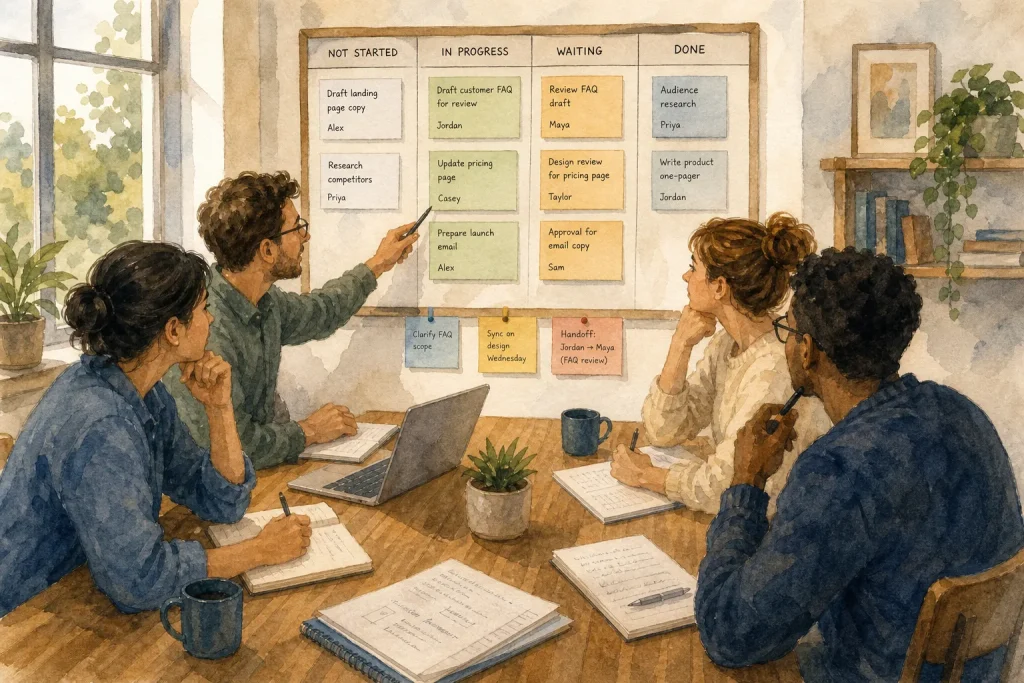
On Monday morning, a team opens its shared task board and sees three items marked “in progress,” but nobody can tell who is waiting on whom. One person has drafted a document, another needs to review it, and a third is preparing the next stage without knowing when the review will happen. A short weekly check-in can make that work visible, clarify the handoff, and give everyone a usable plan for the week.
The meeting is not a tour of every task or a substitute for making decisions as they arise. It is a regular pause to compare the shared record with what people can actually do next. Keep it focused on current responsibilities, blocked work, and explicit handoffs. The process below works for a small team using a project board, a shared spreadsheet, or a plain list.
Choose a format that keeps the conversation focused
Before inviting people, decide whether the check-in should happen in person, by video, or asynchronously in a shared document. Use a live conversation when tasks depend on quick discussion or several people need to resolve a handoff together. An asynchronous check-in can suit a team whose work is mostly independent, provided everyone updates the task record by an agreed time and someone follows up on unclear points.
For a live meeting, choose a recurring time that gives participants a chance to update their tasks beforehand. Set a modest time boundary and use an agenda visible to everyone. The exact duration depends on the team and its workload; the useful limit is the one that leaves enough room to resolve immediate coordination issues without inviting unrelated status reports.
Decide who will facilitate and who will capture changes. In a small group, these roles can rotate. The facilitator keeps the discussion on the agenda, asks for a clear owner when responsibility is uncertain, and moves detailed problem-solving into a separate conversation when it would hold up the rest of the group. The note-taker updates the shared record as people agree on changes.
Choose one source of truth for task details. A board such as Trello or Jira, a shared spreadsheet, or a team document can work; the tool matters less than having one place people agree to check. Avoid maintaining competing versions in meeting notes, chat messages, and personal lists. If a decision is made in conversation, put it in the shared task record before the check-in ends.
Prepare the shared task list before people meet
Ask each participant to review the work they own before the check-in. For every active item, the record should make it possible to answer a few basic questions: What is the task? Who owns it now? What is its current state? What is the next action? Is someone else needed before that action can happen?
Use status labels that describe the work rather than its emotional tone. “Not started,” “in progress,” “waiting,” and “done” are often enough. A label such as “urgent” does not explain whether anyone can act, while “waiting for design review” identifies the dependency. If the team already uses a different set of labels, keep them, but make sure people interpret them consistently.
Ask owners to update task titles or notes when the work has changed. “Prepare launch materials” may be too broad to discuss usefully. A more helpful entry might identify the specific deliverable, such as “Draft the customer FAQ for review.” Add a due date only when there is a real commitment or coordination need; dates that are copied forward without discussion can obscure priorities.
Include blocked tasks, not just completed work or items that look busy. A task is blocked when its owner cannot take the next meaningful action without a decision, input, access, or deliverable from someone else. Name the dependency plainly. “Waiting on approval from Maya” is more useful than “stuck,” because the team can identify what needs to happen next.
Finally, ask participants to flag work that may need to change owners or timing. This gives the group a chance to address capacity and dependencies openly rather than discovering them after one person has already missed a handoff.
Open by agreeing on the week’s priorities
Start by confirming the check-in’s purpose and reviewing the priorities that matter for the coming week. A team may have several active projects, but only some tasks need discussion now. Ask what must move forward, what has a firm dependency, and what can wait if capacity becomes tight.
Do not treat a priority list as a promise that everything on it will be completed. It is a shared view of what deserves attention first, based on current commitments and available capacity. If two tasks compete for the same person’s time, make that conflict visible and decide which one takes precedence or who can help.
Keep the opening short. If participants begin recounting everything they did since the last meeting, bring the conversation back to current ownership and the next action. Progress matters when it changes what the team should do now: a finished draft may need a reviewer, and a delayed approval may alter the order of work.
Review active tasks by owner and next action
Move through the shared list in a predictable order, such as by owner or project. For each item that needs attention, ask the owner to state its current condition and the next action they can take. The goal is not to narrate every detail. It is to check whether the task has a clear owner, an achievable next move, and any relevant dependency.
When an item is progressing normally, confirm the next action and move on. If the owner has finished their part, decide whether the task is complete or should be handed to someone else. If scope has changed, update the description so the list reflects the work the team is now agreeing to do.
For a task that cannot proceed, ask what is missing and who can provide it. Separate a genuine blocker from a task that has simply not been started. The distinction affects the response: a blocker may call for a decision or a handoff, while an unstarted task may need reprioritizing or a clearer commitment.
When a discussion requires technical detail or several possible solutions, record the question and assign the right people to resolve it outside the check-in. Set a concrete follow-up point, such as a short working session or a message with a decision by an agreed time. Do not leave the wider group waiting while a small subset explores every option.
Make each handoff explicit
A handoff transfers responsibility for a task or for a defined part of it. “Can you take a look?” is easy to misread: it could mean a quick opinion, a full review, or ownership of the next stage. State what the incoming person is expected to do, what they need to receive, and when the task should return to the group or move forward.
Before recording a handoff, ask the incoming owner to confirm it. This is not a formality. The person may lack the needed context, access, or capacity. If they cannot accept the task as described, revise the scope, identify another owner, or change the timing. A named owner without agreement is only an assumption.
Record the outgoing and incoming responsibilities where the team can see them. For instance, a writer may remain responsible for revising a document while a colleague owns the review. Those are different tasks and should not be collapsed into a vague shared assignment. If a task is genuinely shared, still identify who will make the next move and who has final responsibility for closing it.
Check that the handoff includes the necessary materials. A reviewer may need the latest document link, the specific questions to answer, and any decisions already made. A developer may need the approved design file and the expected behavior. Clear context reduces avoidable back-and-forth and helps the next person begin without reconstructing the discussion.
Close by reading back the decisions
Reserve the last part of the meeting for a brief read-back. Summarize the tasks that changed, the blockers assigned for follow-up, and each handoff’s new owner and next action. Ask participants to correct anything that does not match their understanding.
Check that every unresolved issue has a named person responsible for the next move. That person may not be able to solve the whole problem, but they should know what they will do: request missing information, arrange a decision, or bring back options. “We’ll look into it” leaves the responsibility spread across the group.
Update the shared task list during the conversation or immediately afterward. Make sure the record shows current ownership, status, relevant dates, and the next action. If chat is used to distribute notes, link to the shared record rather than copying a second version that may become outdated.
End with a clear reminder of when participants should update the board again and how urgent blockers should be raised between check-ins. A weekly conversation should not become a reason to wait several days before flagging a problem. Agree on the channel or method the team already uses for time-sensitive changes.
Hypothetical worked example: handing off a draft
Imagine a three-person team preparing a staff guide. At the start of the check-in, the shared board shows “Write staff guide” assigned to Rowan and marked “in progress.” Rowan has drafted the sections on equipment and room access, but the team still needs a review before the guide can be shared. The review is blocked because nobody has been named to do it, and the document link is missing from the task record.
During the meeting, Rowan explains that the draft is ready for a content review, not final approval. The facilitator asks who can review it and what the reviewer should check. Lee agrees to check the instructions for clarity by the team’s next agreed review point, and Rowan remains responsible for making revisions. The note-taker adds the document link, records Lee as the review owner, and lists “send comments to Rowan” as Lee’s next action.
The expected result is a visible, limited handoff: Lee knows what to review, Rowan knows what will come back, and the team can see the next action. The tradeoff is that the guide is not ready to share until the review and revisions are complete. If Lee cannot take the review without delaying other work, the team should choose another reviewer or adjust the timing rather than leaving the task marked as progressing.
Keep the routine useful as the work changes
After a few check-ins, notice which parts create clarity and which repeatedly consume time without changing decisions. If the team spends too long reading status labels aloud, ask owners to update the board beforehand and discuss only changes, blockers, and dependencies. If handoffs are often unclear, add a brief prompt to the task template for “incoming owner” and “next action.”
Adapt the routine when the work changes. A team with many interdependent tasks may need to review blockers first. A group whose assignments are mostly independent may benefit from a short written update and a live discussion only when someone requests coordination. Keep the shared record stable enough that people know where to look, but revise the process when it no longer supports the work.
A useful check-in leaves people with fewer assumptions than they brought into it. Before closing, make sure every active task has a current owner, each blocker has a next move, and every accepted handoff has a clear scope. That small discipline helps the team spend the rest of the week doing the work instead of trying to reconstruct who agreed to do what.